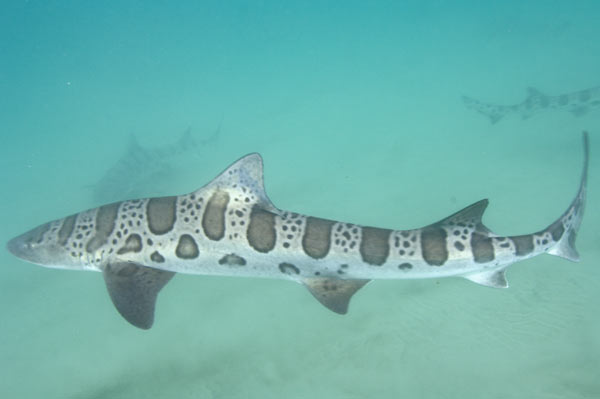
Common Names: Leopard Shark. Latin Name: Triakis semifasciata Family: Triakidae Identification: Easily distinguished by bold pattern of large dark saddles extending from the head along the back. Centre of saddles lighter in adults. Saddles are separated by smaller dark spots on a cream to grey/brown background. Overall body shape is elogated and slender. Second dorsal proportionately large. Pectoral fins falcate. Snout broadly rounded with widely spaced nasal flaps that do not reach mouth. Albino Leopard sharks have rare but have been recorded. Size: Maximum recorded size 180cm. Size at birth 20cm. Habitat: Prefers shallow sand flats and confined muddy bays. Likes turbid water. Occasionally in or near kelp beds on rocky substrate. Abundance and distribution: Confined to the temperate and tropical coastline between Oregon and Southern Baja including the Sea of Cortez. Often seen in large aggregations close to shore. Usually intertidal to 4m but has been recorded as deep as 91m. Diet: Hunts over sand in search of burrowing invertebrates such as worms but will feed opportunistically on a wide variety of animals including crustaceans, squid, bony fishes, and small sharks and rays (mainly other smoothhounds, bat rays and guitarfishes). Behavior: The Leopard Shark sometimes forms nomadic schools with other species especially the Grey Smoothhound (Mustelus californicus) and Spiny Dogfish (Squalus acanthias). Usually maintains a small home range but can roam up to 150km. A strong swimming shark that can occasionally be seen resting among rocks. Reproduction: Ovoviviparous with no yolk sac placenta. Recorded litter size 4-29. Gestation period approx. 12 months. Slow growing and late to mature.
|  _02.jpg.opt347x260o0,0s347x260.jpg) |
Goblin Shark Overview - Form may follow function, but it does not always have to be pretty. While the goblin shark is well adapted for its deep-sea habitat, some people have referred to this fish as “the ugliest living shark.” Still others liken it to an alien from outer space. Its mostly pink body contains soft, flabby flesh. Perhaps its most distinguishing feature is its uniquely shaped head. The shark’s beak-like snout protrudes like a trowel, making it perfect for investigating muddy ocean bottoms. When the goblin shark retracts its jaws, the snout looks more like a really long, pink nose. Since this shark frequents deep waters, sunshine does not provide much light at such levels. The goblin shark, therefore, has very small eyes, and must often rely on its other senses for detecting predators and prey, as well as for directing movements | 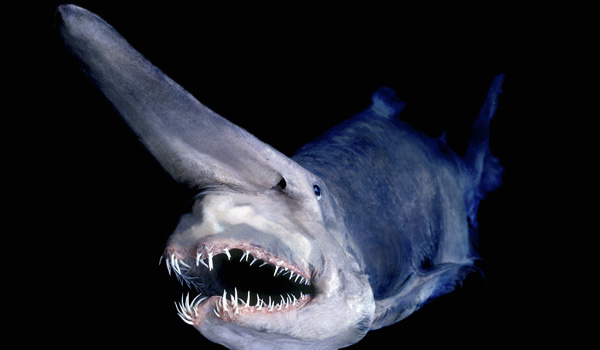 |
